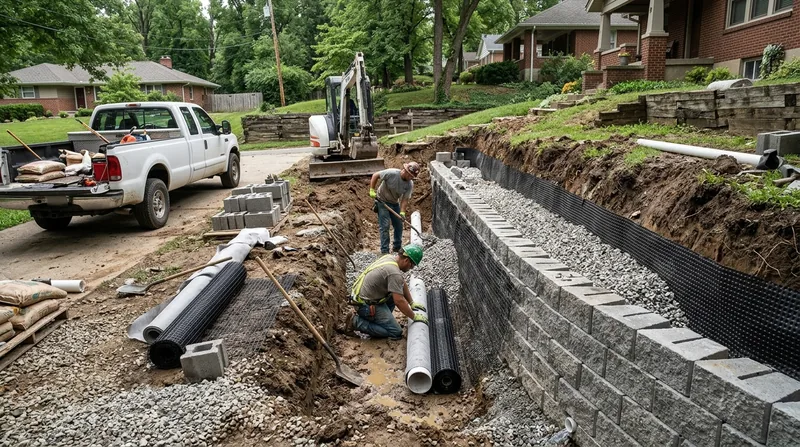




Retaining wall drainage in Indianapolis is the difference between a wall that lasts 20 years and one that fails in five. Indianapolis sits on dense clay till that holds water like a sponge. When spring thaw and heavy rains saturate the soil behind your wall, hydrostatic pressure builds. That pressure pushes outward, tips the wall forward, and cracks it from the inside out. It is the number one reason retaining walls fail in central Indiana, and it is entirely preventable with proper drainage design and installation.
Whether your wall is a segmental block structure around a walkout basement in Fishers, an Indiana limestone outcropping in Irvington, or aging railroad ties in Lawrence, water management is not optional. We install French drains, weep holes, gravel backfill systems, and waterproofing membranes that relieve pressure and keep your wall standing plumb and straight for decades. This page covers how drainage works, what methods we use, and what to expect when you call.
Why Retaining Wall Drainage Fails in Indianapolis: Clay Till and Freeze-Thaw Cycles
Indianapolis drainage failures are not random. The glacial clay till that underlies the city and its townships (from Carmel to Greenwood to Plainfield) is impermeable. Water does not percolate down, it pools behind walls. Add Indiana's freeze-thaw cycle, where January temperatures swing 40 degrees in a week, and ice lenses form in saturated soil. Frozen water expands. It pushes walls outward with tremendous force. By spring, the wall has moved. Cracks appear. Water enters the cracks and repeats the cycle.
A wall without drainage becomes a dam. Hydrostatic pressure is relentless and invisible until the wall leans, bulges, or collapses.
- We install French drains behind the wall to intercept groundwater and route it away from the footing.
- We drill weep holes through the wall face to allow trapped water to escape before pressure builds.
- We use gravel backfill and drainage fabric to create a permeable zone that sheds water downslope.
- We apply waterproofing membranes to the back face of the wall to prevent water from soaking into the structure itself.
- We slope the grade away from the wall so surface water runs off instead of pooling.
Each of these methods addresses a different path that water takes to destroy a wall. Together, they keep pressure off the structure and extend its life by decades.
Key info: Indianapolis building inspectors know clay till drainage is critical. If your wall is over 4 feet tall or supports a surcharge (like a driveway or deck), check with your local building department for permit requirements and whether engineered drainage drawings are required. Setback and property-line rules also apply. Always verify with your jurisdiction before design begins.
For permit and regulatory guidance, visit the Indianapolis Department of Code Enforcement to confirm thresholds and submission requirements in your area.
How We Design and Install Retaining Wall Drainage in Indianapolis
Drainage design starts with site assessment. We look at the soil type, groundwater depth, surface water flow, and the wall's height and orientation. In Indianapolis, we assume clay till and plan for saturation. We then select the right combination of methods for your wall material and location, whether it is segmental block in Noblesville, poured concrete in Westfield, or natural stone in Greenwood.
Installation happens during construction or as part of a repair job. If the wall is new, we build drainage into the backfill. If it is existing and failing, we may need to excavate behind the wall to install a new French drain system. Either way, the goal is the same: move water away from the wall before it becomes a problem.
- We excavate the backfill zone and assess soil conditions and existing water flow patterns.
- We install perforated drain pipe in a bed of gravel wrapped in drainage fabric to capture and route groundwater.
- We drill weep holes through the wall at regular intervals (typically 4 to 6 feet apart) to release trapped water.
- We backfill with free-draining material (crushed stone, not soil) up to grade, and slope the surface away from the wall.
- We may apply a waterproofing membrane to the wall face if moisture is a concern.
- We confirm that the drain outlet (daylight or to a storm drain) is clear and functioning.
The entire process is designed to prevent water from ever building up enough pressure to move the wall. See our retaining wall repair page for details on how we handle walls that are already leaning or cracked.
Example: A homeowner in Irvington had a 6-foot Indiana limestone garden wall that was weeping water and showing horizontal cracks after three winters. We excavated 3 feet behind the wall, installed a French drain with a daylight outlet to the side yard, drilled four weep holes through the face, and backfilled with gravel. The wall stopped weeping within days. Two years later, no new cracks have appeared. The drainage system intercepts water before it reaches the wall.
Retaining Wall Drainage Methods and When to Use Each
| Approach | Description | Best For |
|---|---|---|
| French Drain | Perforated pipe in gravel wrapped in fabric, installed behind the wall to intercept and route groundwater downslope or to a storm drain. | High water table, clay till, walls over 4 feet, or where surface water pools behind the wall. |
| Weep Holes | Drilled or cast openings through the wall face (typically 3/4 to 1 inch diameter) at regular intervals to allow trapped water to escape. | Segmental block, concrete, and stone walls where water is already behind the structure. |
| Gravel Backfill & Fabric | Free-draining crushed stone (not soil) behind the wall, separated from clay backfill by drainage fabric, to allow water to flow downward and away. | All wall types in Indianapolis; required to prevent water from pooling in the backfill zone. |
| Waterproofing Membrane | Liquid or sheet waterproofing applied to the back face of the wall to prevent water absorption into the structure. | Concrete and stone walls, or where water seepage through the wall face is a concern. |
| Grade Slope & Surface Drainage | Finished grade sloped away from the wall at 5 percent or steeper to shed surface water and prevent ponding at the base. | All walls; often the simplest and most cost-effective first line of defense. |
Most Indianapolis walls need a combination of these methods. A new segmental block wall in Fishers might use weep holes, gravel backfill, and proper grading. An older poured concrete wall in Plainfield that is failing might need a full French drain system plus a waterproofing membrane. We assess each wall individually and recommend the methods that will stop water and extend the wall's life.
Retaining Wall Drainage Cost in Indianapolis: What to Expect
Retaining wall drainage costs in Indianapolis start at around $2,500 for a straightforward project like adding weep holes and improving grading on a 20-foot block wall. A full French drain installation behind a 30-foot wall with excavation, piping, and a daylight outlet typically runs $4,000 to $7,000. Waterproofing membranes add $500 to $1,500 depending on wall area. If the wall is tall, the site is tight, or soil conditions are poor, costs move higher.
The main factors that affect price are wall length, the depth of excavation required, access for equipment, soil conditions, whether a new drain outlet must be created, and whether the wall is existing or under construction. A wall in a tight backyard with no room for a skid-steer will cost more than one in an open lot. Clay till that is hard-packed takes longer to excavate than loose soil. We always provide a detailed estimate after a site visit so you know what you are paying for and why.
Get two or three estimates from licensed contractors before you decide. Drainage is not a commodity, and low price often means shortcuts. For a full pricing overview and to discuss your specific wall, visit our pricing page or call us at (463) 217-0386 for a free, no-obligation estimate.
Retaining Wall Drainage Near Me: What to Look for When Hiring a Contractor in Indianapolis
Hiring the right contractor for retaining wall drainage is as important as the drainage design itself. A contractor who cuts corners on backfill or skips weep holes will leave you with a wall that fails in a few years. Look for a contractor who is licensed, insured, and has experience with clay till and Indianapolis-specific conditions.
Ask for references from recent drainage jobs, not just installations. Request proof of insurance and a current business license. Understand what the estimate includes: materials, labor, equipment, permits, and cleanup. Ask about the drain outlet and how water will be routed away from your property. If your wall is over 4 feet or supports a structure, confirm that the contractor will pull permits and work with your local building department. If you have an HOA, verify that the work complies with covenants.
Never hire based on price alone. A drainage system that fails costs far more to repair than it does to install correctly the first time. Contact us today for a free estimate and a straightforward conversation about your wall and your options.
Retaining Wall Drainage in Indianapolis: Pricing Guide
| Service | Price | Details |
|---|---|---|
| Weep Hole Installation | Starting at $2,500 | Drilling and installing 4 to 8 weep holes through existing wall face to release trapped water pressure |
| French Drain System | Starting at $4,500 | Perforated drain pipe, gravel, fabric, and daylight outlet installation behind wall; cost rises with wall length and excavation depth |
| Waterproofing Membrane | Starting at $800 | Liquid or sheet waterproofing applied to wall back face to prevent water absorption; priced per square foot of wall area |
| Full Drainage System (French Drain, Weep Holes, Gravel, Membrane) | Starting at $6,500 | Complete solution for existing failing walls; includes excavation, piping, holes, backfill, and waterproofing; final cost depends on wall size and site conditions |
| Estimate and Site Visit | Free | We assess soil, water flow, wall condition, and access to provide a detailed written estimate within 24 hours of your call at (463) 217-0386 |
Indicative pricing, the exact cost depends on square footage, finish, and site access. Free personalized estimate within 24h at (463) 217-0386.


